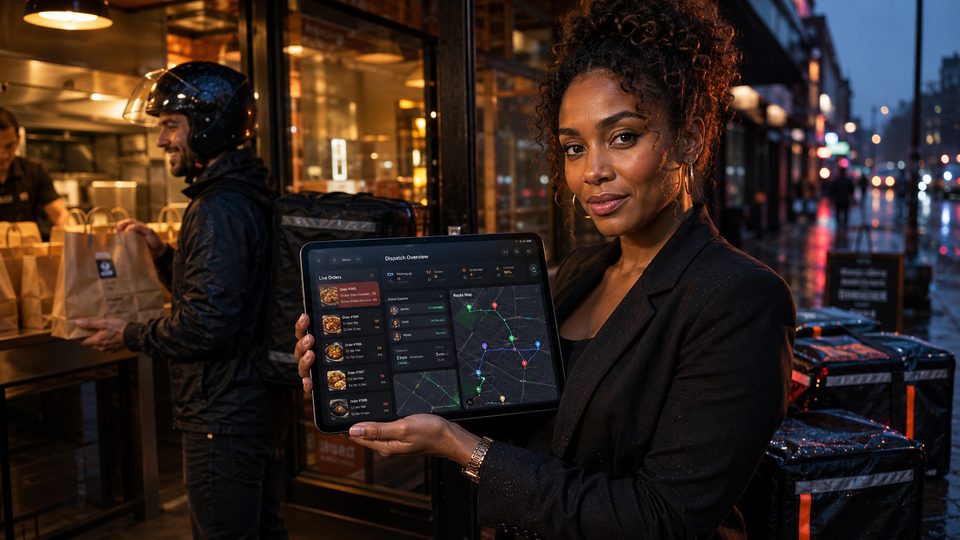
Delivery zones decide which journeys the business is willing to promise. Minimum orders and delivery fees decide whether those journeys can make commercial sense. These controls should be designed together from travel time, density, capacity and contribution — not copied from nearby competitors.
Build zones around operating conditions
Useful inputs include:
- observed journey time by daypart;
- postcode and address quality;
- parking, flats, gates and difficult access;
- order density;
- food suitability for the journey;
- driver availability and return time;
- weather and seasonal variation;
- third-party provider coverage.
Choose a zone method that can be maintained
| Method | Strength | Limitation |
|---|---|---|
| Postcode sectors | Clear customer eligibility and reporting | Can hide local barriers and journey variation |
| Road distance | Closer to actual travel than straight-line radius | Still changes by traffic and access |
| Journey time | Operationally meaningful | Requires current mapping and daypart rules |
| Named neighbourhoods | Easy for staff to understand | Boundaries may be ambiguous at checkout |
Set minimum orders from contribution
The minimum should consider food gross profit, packaging, payment cost, delivery labour or provider fee, promotional funding, failed-delivery allowance and the opportunity cost of kitchen capacity. A minimum order does not need to cover every cost alone, but it should support a deliberate commercial model.
Use different rules where justified
Outer zones may have a higher minimum, different fee or fewer time slots. Peak periods may require a reduced area rather than an arbitrary surcharge. Keep the rules understandable and show mandatory charges clearly before the customer commits.
Avoid common mistakes
- using one large radius for every period;
- offering free delivery without modelling contribution;
- keeping remote postcodes open for rare orders;
- ignoring the return journey;
- using a minimum that encourages oversized, low-margin baskets;
- changing zones without testing existing saved addresses and pre-orders;
- hiding the delivery fee until the final checkout step.
Review with zone-level evidence
Measure orders, average contribution, journey time, failed delivery, complaints, refunds and driver utilisation by zone and period. Do not remove an area solely because its average order value is low if it produces dense, reliable routes; equally, do not keep an area solely because individual baskets look large.
Control zone changes like a release
A zone change can affect price, promise, saved addresses, pre-orders, marketplace coverage and reporting. Record the old and new values, approval, publication time and rollback. Test representative postcodes on every active channel. If one channel has stale rules, close or correct it before accepting conflicting orders.
Keep customer-service rules aligned
Staff should know whether an address is unsupported, temporarily restricted or available only at another time. Avoid promising an exception by telephone when the kitchen and driver plan does not include it. Log recurring requests from excluded areas as evidence for a future controlled test.
Practical next step: classify the last month’s deliveries by postcode and service period, then compare full delivery cost and reliability before changing the customer-facing map.
Official UK price-transparency reference
Guidance checked: 24 July 2026. Mandatory delivery and service charges should be presented clearly before the customer commits to the purchase.
Related guides
- Delivery Management — the main guide for the wider topic.
- Delivery Pricing Models — a detailed next step for putting this guidance into practice.
- How to Manage Multiple Delivery Zones — a detailed next step for putting this guidance into practice.
- Delivery Packaging and Equipment — a closely related operational control to review alongside this page.
- Driver Tracking and Communication — a closely related operational control to review alongside this page.