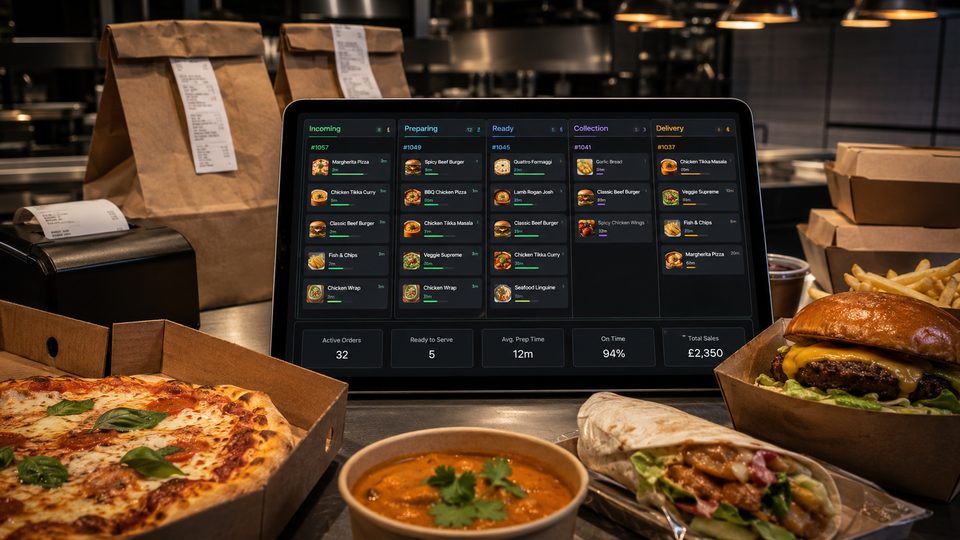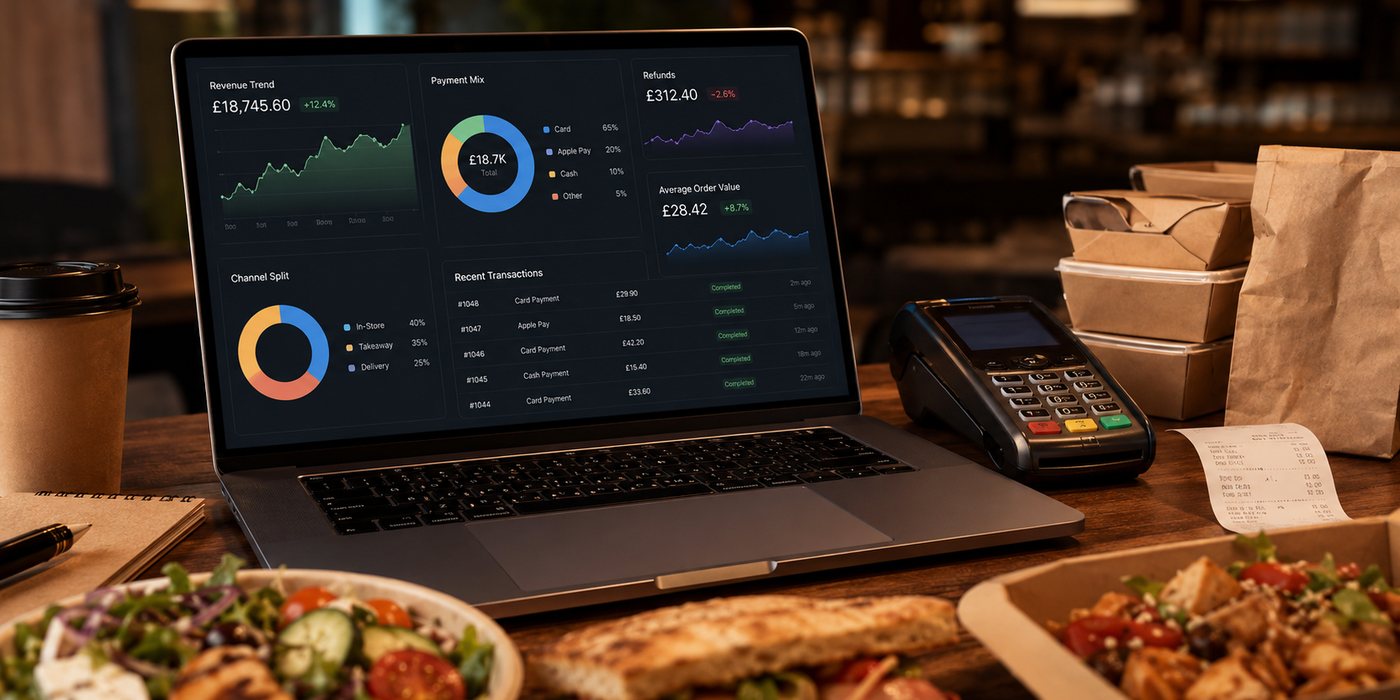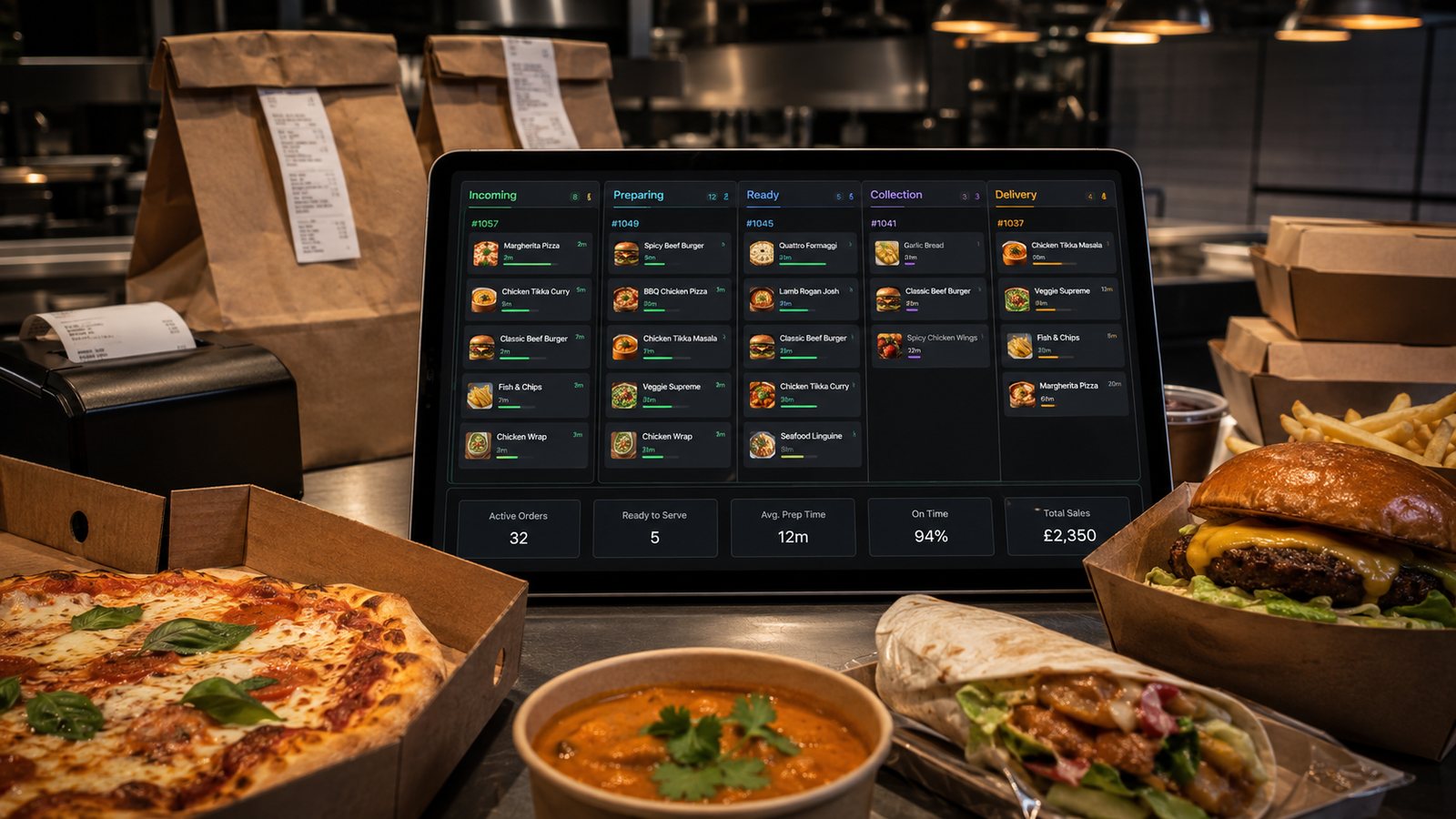
A takeaway should treat website, app, marketplace, telephone and walk-in demand as one operation with several entry points. Separate screens and contracts must not create separate kitchens.
Design one shared operating model
Every order needs a source, fulfilment type, payment status, promised time and accountable owner. The business may keep channel-specific commercial rules, but acceptance, kitchen routing, capacity, food-safety controls, packing and incident handling should use a common operating language. This prevents one channel from quietly consuming capacity while another continues to promise unrealistic times.
| Operational layer | Shared control | Channel-specific variation |
|---|---|---|
| Order intake | Unique order record and duplicate control | Device, API, telephone or counter entry |
| Menu | Approved products, modifiers and allergens | Range, price or promotion exceptions |
| Capacity | One view of committed kitchen workload | Slots, zones and acceptance rules |
| Kitchen | Station routing, checking and handover | Packaging and fulfilment instructions |
| Customer support | One incident record and remedy policy | Marketplace or direct support route |
| Finance | Order-to-payment reconciliation | Provider statements and deductions |
Use the guides by operational problem
- Accepting Orders from Multiple Sources covers devices, integrations and the first controlled order record.
- Kitchen Workflow for Multi-Channel Orders covers priority, station routing and the pass.
- Channel-Specific Operations defines what genuinely differs between telephone, walk-in, social and digital channels.
- Operational Efficiency covers workload, preparation, timing and staffing.
- Multi-Channel Order Management covers broader governance, fallback and reconciliation.
Establish a common status model
Do not allow each platform label to become its own operational language. Map provider statuses to a small controlled set such as received, awaiting decision, accepted, in preparation, ready, handed over, completed, cancelled and exception. Preserve the original provider event for audit, but train staff on the common status and the action that it requires.
Control shared capacity
Capacity should reflect station workload, packing, driver availability and collection handover. A marketplace tablet, direct website and phone line cannot each assume the whole kitchen is available. Define green, amber and red operating states with approved actions: extend promises, reduce slots, pause complex items, narrow delivery zones or stop accepting a channel. The shift lead should be able to apply controls without waiting for several supplier support teams.
Protect channel-specific exceptions
Some differences are legitimate. A marketplace may require its own refund workflow; a walk-in customer can clarify an item at the counter; a telephone order may need verbal read-back; a social message should usually be moved to a controlled checkout. Record these exceptions explicitly. Do not solve them with hidden workarounds that depend on one experienced member of staff.
Run a cross-channel service review
Review completed orders, promise accuracy, corrections, refunds, kitchen bottlenecks, driver waits, collection queues and unmatched payments by source and fulfilment type. Compare like with like. A channel that receives mainly small collection orders should not be judged against one carrying large delivered baskets without adjustment.
Prepare for partial failure
- Keep current contact and escalation details for every provider.
- Document how to pause each intake source.
- Maintain a minimal manual order record.
- Define how payment uncertainty is checked before retaking an order.
- Protect approved allergen and menu information during fallback.
- Reconcile manually accepted orders after recovery.
Practical next step
Take one busy thirty-minute period and reconstruct every order across all channels on a single timeline. Mark when the order was received, accepted, started, ready and handed over. The overlaps and missing events will show where the shared operating model is weak.
Related guides
- Channel-Specific Operations — a detailed next step for putting this guidance into practice.
- Multi-Channel Order Management — a detailed next step for putting this guidance into practice.
- Business Planning and Finance — a closely related operational control to review alongside this page.
- Delivery Management — a closely related operational control to review alongside this page.
- Online Ordering — a connected decision that can change the recommended approach.
- POS and Kitchen Systems — a connected decision that can change the recommended approach.