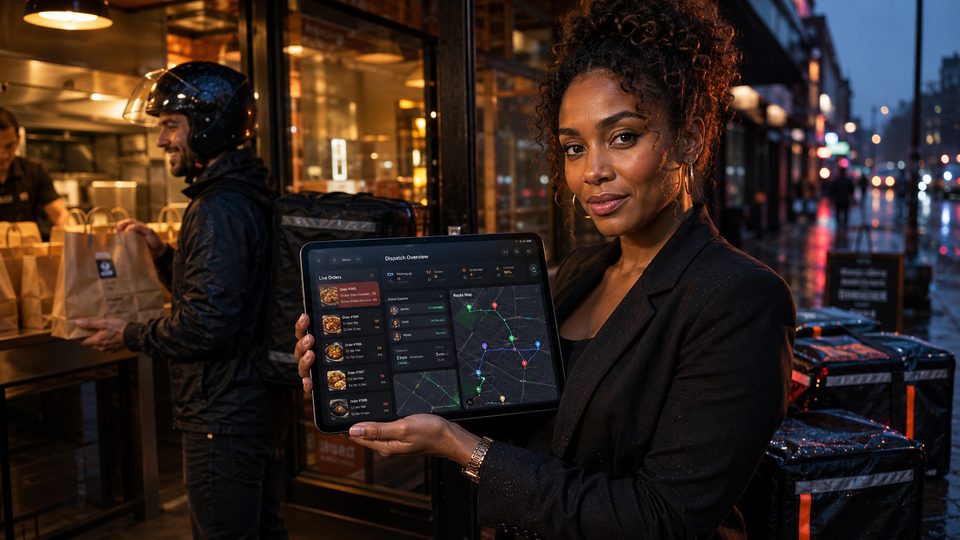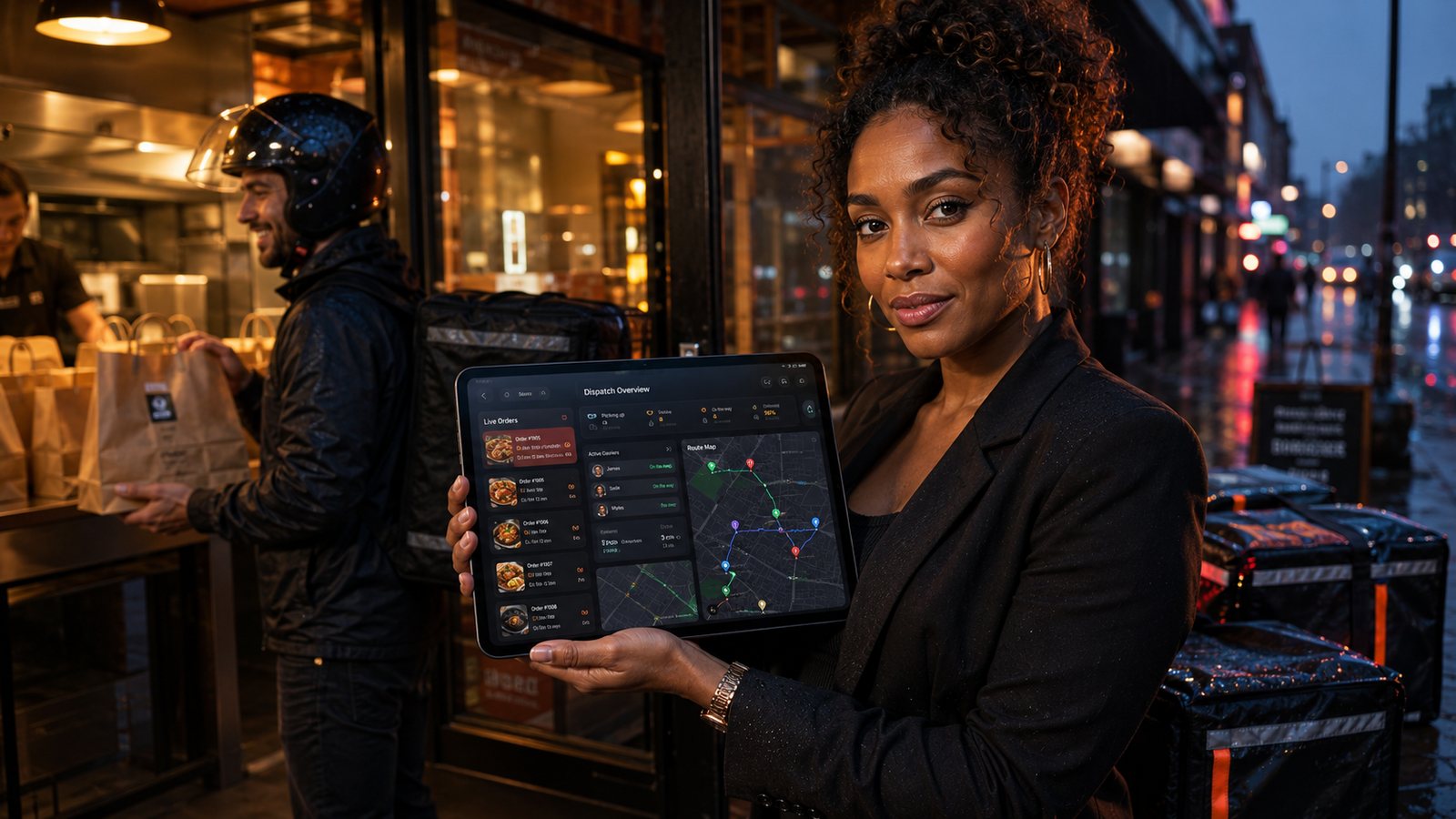
Delivery is not a separate add-on to online ordering. It is an operating system that links the promise shown at checkout with kitchen capacity, packing, driver availability, customer communication and final payment reconciliation. A wide radius and fast headline time can attract orders, but they damage trust if the kitchen and delivery operation cannot fulfil them consistently.
This hub helps independent UK takeaways design that system. It also directs readers to the detailed guides on delivery models, zones, minimum orders, drivers, tracking, routing, failed deliveries, packaging and peak-period control.
Map the complete delivery flow
- The customer enters an address and selects delivery.
- The system validates the postcode, zone, minimum order, fee and available time.
- The kitchen accepts the order against real capacity.
- Items are prepared, checked, packed and labelled for handover.
- A driver is assigned with the correct address, contact route and notes.
- The customer receives useful status information rather than false precision.
- Delivery completion, complaints, redelivery and refunds remain traceable.
- Sales, delivery charges, driver costs and provider deductions can be reconciled.
Draw this flow for direct, marketplace and telephone orders. Mark where data is re-entered, where a person must make a judgement and where a failure can leave the customer charged without a deliverable order.
Choose the delivery model deliberately
| Model | Main advantage | Main operational exposure |
|---|---|---|
| Own drivers | Control over training, handover and customer experience | Recruitment, scheduling, road risk, vehicles, insurance and idle time |
| Third-party driver platform | Flexible capacity without maintaining a full driver team | Variable availability, provider rules, support handoffs and less direct control |
| Marketplace delivery | Customer discovery and an integrated delivery network | Contract-specific fees, customer relationship limits and platform dependency |
| Mixed model | Different capacity for normal and peak demand | More complex dispatch rules and reconciliation |
A mixed model is not automatically more resilient. It works only when staff know which provider owns each order, who communicates with the customer and how duplicate dispatch is prevented.
Set zones from journey time and workload
A postcode radius is only a starting point. Zone design should consider actual travel time, road layout, parking, building access, order density, weather, kitchen preparation and the food’s ability to travel well. A short urban journey can take longer than a greater distance on a clear route.
Use different rules where necessary for:
- minimum order;
- delivery fee;
- available time slots;
- peak-hour restrictions;
- menu availability;
- own-driver and third-party coverage.
Control the promise before the order arrives
The quoted time should be built from current kitchen workload, preparation time, packing, assignment and realistic travel. It should change before service fails, not after a queue has already become unmanageable. Capacity controls may include longer estimates, fewer slots, a smaller zone, temporary channel throttling or pausing delivery while collection remains open.
Build a clear handover
- Use a unique order identifier visible on every bag or label.
- Separate collection orders from driver orders.
- Confirm the full bag count before release.
- Keep drinks, hot food and cold items organised for the journey.
- Record who received the order and when it left.
- Give the driver only the customer information needed for that delivery.
Measure the operation, not only the headline time
Useful measures include acceptance delay, kitchen-ready time, wait at handover, journey time, promised-versus-actual arrival, failed delivery, missing-item complaints, redeliveries, refunds, cost per completed delivery and contribution by zone. Review the distribution and the exceptions rather than relying only on an average.
Plan the failure modes
Document what staff should do when a driver is unavailable, an address is wrong, the customer does not answer, the tracking service fails, food is damaged, weather becomes unsafe or a payment/refund status is uncertain. The plan should identify who can contact the customer, change the promise, authorise a remedy and close the record.
Routes through this section
- Start or redesign delivery: use the delivery operations overview and first-time setup guide.
- Choose fulfilment capacity: compare own drivers with third-party delivery.
- Control geography and economics: use the zones, minimum-order and pricing guides.
- Improve dispatch: use tracking, communication, routing and density guides.
- Reduce service failures: use the failed-delivery, complaint and remedy guides.
- Protect food quality: use the packaging, bags and equipment guides.
Practical next step: take ten recent delivery orders and reconstruct the full timeline from checkout to completion. Mark every delay, manual handoff, missing record and promise that was not based on live capacity.
Official UK guidance
- Food Standards Agency: Food safety for food delivery
- Health and Safety Executive: Driving and riding safely for work — guidance for employers
Guidance checked: 24 July 2026. Recheck official guidance, local food-safety arrangements and insurance requirements when the delivery model, vehicles or workforce change.
Related guides
- Delivery Operations Overview — a detailed next step for putting this guidance into practice.
- Delivery Packaging and Equipment — a detailed next step for putting this guidance into practice.
- Cross-Channel Operations — a closely related operational control to review alongside this page.
- Online Ordering — a closely related operational control to review alongside this page.
- Business Planning and Finance — a connected decision that can change the recommended approach.
- POS and Kitchen Systems — a connected decision that can change the recommended approach.