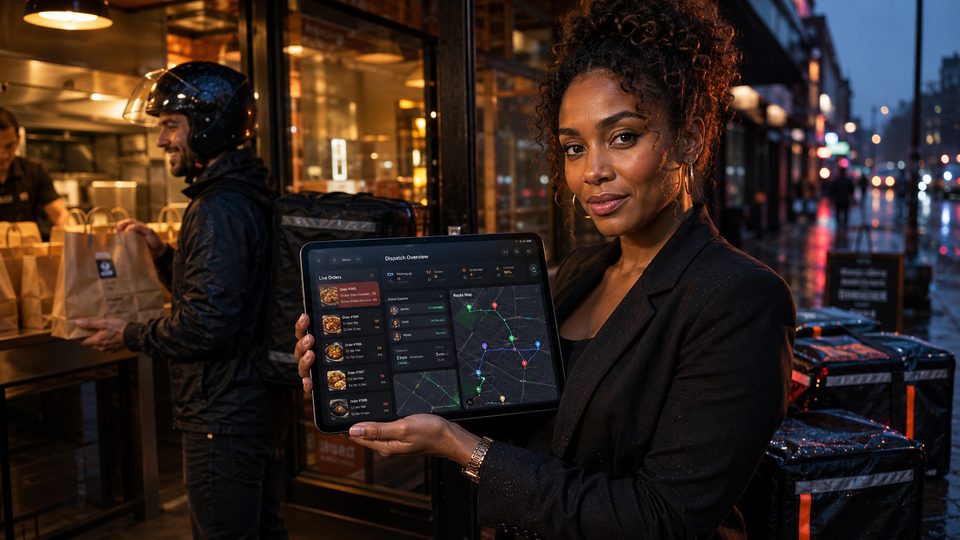
Takeaway route planning is a time-sensitive coordination problem rather than a simple search for the shortest distance. Food readiness, customer promises, bag capacity, access, driver position and the cost of returning for the next order all matter. The route that covers fewer miles can still produce a worse result if it makes the first order wait too long.
Separate three decisions
- Assignment: which driver should receive the order?
- Grouping: can two or more orders travel together safely and within promise?
- Sequence: in what order should the stops be completed?
Do not allow software to group orders solely because the postcodes are nearby. Check ready time, promised arrival, food suitability, bag separation and difficult access.
Create the information needed for dispatch
- restaurant order and delivery-job IDs;
- ready time and promised window;
- address validation and access notes;
- bag count and product-separation needs;
- driver availability and vehicle capacity;
- current traffic or route disruption;
- customer-contact and exception process.
Use simple controls before complex optimisation
For a small operation, a clear dispatch board sorted by ready time and area may outperform an automated tool that staff do not understand. Introduce optimisation when order volume and route complexity justify it, and keep the ability to override unsafe or unrealistic recommendations.
Measure the full route outcome
| Measure | What it reveals |
|---|---|
| Driver wait at restaurant | Assignment too early or kitchen uncertainty |
| Food wait after ready | Assignment too late or insufficient capacity |
| Stops per journey | Grouping use, but not quality by itself |
| Promised-versus-actual arrival | Customer reliability |
| Distance and paid time per completed drop | Operational cost |
| Complaints by route pattern | Over-grouping or unsuitable zones |
Routes through this section
Use Delivery Route Optimisation for assignment, grouping and software evaluation. Use Managing Delivery Density for zone concentration and low-density areas.
Give dispatchers clear grouping rules
Define when grouping is allowed, who approves it and when an order must travel alone. Consider ready-time gap, promised window, route direction, food type, packaging, bag capacity and access. A manual override should record the reason so recurring exceptions can improve the rule.
Plan the return journey
The driver is not fully available at the first customer’s door. Include the remaining stops and return to the takeaway or next collection point. Outer-zone work can remove capacity for much longer than the outward journey suggests.
Review route decisions, not only driver outcomes
If a delivery is late, distinguish kitchen delay, assignment timing, route design, access and driver action. Avoid treating the driver as the cause simply because the final stage is visible. Route planning is a management decision and should be reviewed with the same care as kitchen capacity.
Maintain route data quality
Review repeated address corrections, missing access notes and unrealistic ready times. Correct the source rather than expecting dispatchers to compensate every shift. A small data-cleaning routine can improve routing more reliably than additional optimisation features.
Include local road closures and recurring building-access restrictions in the dispatch reference.
Practical next step: review twenty delivery journeys and mark where grouping improved the route and where it damaged the first customer’s promise.
Related guides
- Delivery Management — the main guide for the wider topic.
- Delivery Route Optimisation — a detailed next step for putting this guidance into practice.
- Managing Delivery Density — a detailed next step for putting this guidance into practice.
- Peak Period Delivery Management — a closely related operational control to review alongside this page.
- Delivery Operations Overview — a closely related operational control to review alongside this page.