Delivery Route Optimisation
Route optimisation should improve completed-delivery cost and reliability without encouraging unsafe driving or excessive order grouping. The system needs accurate inputs and clear constraints; otherwise it merely cal…
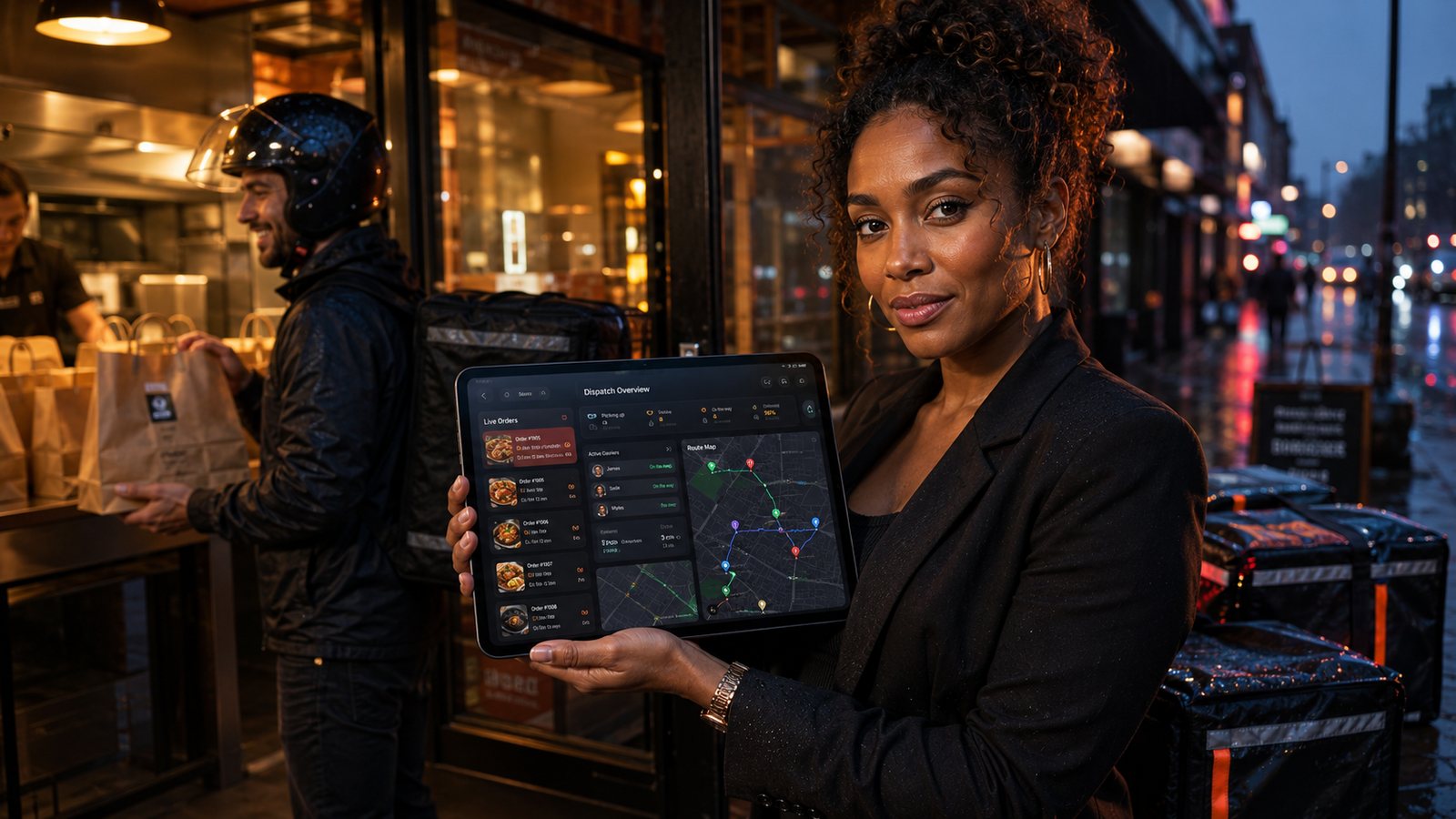
Route optimisation should improve completed-delivery cost and reliability without encouraging unsafe driving or excessive order grouping. The system needs accurate inputs and clear constraints; otherwise it merely calculates a precise answer to the wrong problem.
Define the optimisation objective
Possible objectives include:
- meeting promised arrival windows;
- reducing food wait after preparation;
- reducing driver distance and paid time;
- increasing reliable grouped drops;
- balancing work between drivers;
- protecting outer-zone coverage.
Choose priorities explicitly. Minimising distance alone may delay a time-critical order.
Use realistic constraints
| Constraint | Why it matters |
|---|---|
| Ready time | An order cannot leave before preparation and checking |
| Promise window | Grouping must not break the customer commitment |
| Bag and vehicle capacity | Physical capacity and product separation limit grouping |
| Access time | Flats, gates and parking change route duration |
| Driver shift and break | Availability is not unlimited |
| Food suitability | Some items tolerate grouping poorly |
Evaluate software with historical orders
Use actual Friday or event-night data. Compare the proposed route with what happened, including late-ready orders and failed addresses. Ask how the tool updates after cancellation, reassignment, traffic or preparation delay. Confirm whether staff can understand and override the recommendation.
Control multi-drop delivery
- Set a maximum journey and stop rule based on food and service evidence.
- Do not group only because two destinations share a postcode.
- Label bags and sequence them to prevent the wrong handover.
- Show the customer a realistic promise rather than hiding the extra stop.
- Review complaints and remakes associated with grouped routes.
Avoid unsafe incentives
Do not score drivers solely by route speed or compare journeys without context. The route plan and customer promise should allow lawful, safe travel. A late but safe delivery is an operational planning issue, not evidence that the driver should take greater risks.
Pilot with a rollback
Test one shift or zone, then compare promised arrival, food wait, driver distance, paid time, complaints and manual overrides. Roll back if the tool improves distance while worsening service or staff control.
Protect input quality
Optimisation depends on accurate ready times, validated addresses and current driver availability. Create exception flags for missing access notes, uncertain preparation and stale GPS. The tool should not silently optimise around bad data.
Define dispatcher override and escalation
Staff need to know when they may reject a route, split a batch or change the sequence. Record the override and outcome. Repeated overrides may show that the constraints or travel assumptions are wrong rather than that staff resist automation.
Plan implementation and exit
Confirm integration fields, support ownership, mapping provider, data export and contract terms. Run the optimiser in shadow mode before allowing automatic assignment. Keep the previous dispatch method available during the pilot and document how to return to it if routing or status updates fail.
Review automated decisions
Sample routes regularly and compare the recommendation with the actual outcome. Investigate repeated manual overrides, excessive driver waiting and customer promises missed after grouping. Update constraints only through a controlled change with a test and rollback.
Practical next step: give suppliers ten difficult historical routes and require them to show how the system handles late preparation, access delays and reassignment.
Related guides
- Delivery Management — the main guide for the wider topic.
- Route Planning and Efficiency — the broader guide that frames this implementation.
- Managing Delivery Density — a closely related operational control to review alongside this page.
Operational, legal and platform requirements can change. Recheck official guidance and supplier documentation before altering a live service.
Related practical guides
 Delivery ManagementHow to Plan Driver TrackingDriver tracking should begin with a documented operational need, not a map feature. This method helps a takeaway choose the minimum system needed…Read guide →Delivery ManagementHow to Plan Delivery MinimumsA delivery minimum should protect the economics of the journey without forcing customers into an unsuitable basket. It is one control among sever…Read guide →Delivery ManagementHow to Manage Multiple Delivery ZonesMultiple zones allow a takeaway to reflect different journey times, costs and service levels. They also create more opportunities for configurati…Read guide →
 Delivery ManagementDelivery Pricing ModelsA delivery charge should be a deliberate part of the commercial model, not a copy of a competitor’s checkout. The right structure depends on zone…Read guide →Delivery ManagementDelivery During Busy PeriodsBusy-period delivery should be controlled as one system with the kitchen. Adding drivers alone will not solve a queue that is already late before…Read guide →Delivery ManagementEmploying Delivery DriversTaking on delivery drivers creates more than a rota. The business needs a lawful working arrangement, safe journeys, suitable vehicles, clear pay…Read guide →
Connect customer ordering with operations and profit
Use the wider guide library to check the menu, kitchen, fulfilment, payment and financial implications of each decision.
Browse all practical guides