Cash Drawers and Security
Cash control should protect staff, customers and business records while keeping counter service practical. Combine POS permissions, physical security, reconciliation and violence-risk controls rather than relying on o…
Cash control should protect staff, customers and business records while keeping counter service practical. Combine POS permissions, physical security, reconciliation and violence-risk controls rather than relying on one lock or camera.
Define the cash model
List every place cash can enter or leave: counter sales, telephone orders paid on collection, driver collections, refunds, floats, paid-outs, safe drops and banking. Decide whether drawers are assigned to individuals, shifts or positions. Shared drawers may be operationally convenient, but they weaken accountability unless handovers and access are recorded.
Select compatible drawer hardware
| Feature | Control question |
|---|---|
| Connection | Does the POS open it only for approved events, and what happens if the printer or terminal fails? |
| Lock and key | Who holds keys, how are copies recorded, and can emergency access be audited? |
| Removable insert | Can cash be counted and transferred without carrying the whole drawer? |
| Placement | Is it secure, discreet and safe for staff movement? |
| Open sensor | Can the system record a drawer left open or opened without a sale? |
Use role-based POS permissions
Restrict no-sale opening, refunds, voids, price overrides and paid-outs. Avoid shared manager codes. Require a reason and audit entry for exceptional opening. Review access after staff changes. A technical restriction should support, not replace, supervision and a clear procedure.
Control floats and shift handovers
- Count the float away from the public area where possible.
- Record denomination totals and responsible person.
- Seal or secure the insert before transfer.
- Confirm the handover in the POS or cash log.
- Investigate differences at the earliest practical point.
Do not leave unresolved differences until the end of a long period when the evidence is harder to reconstruct.
Reduce cash exposure during service
Set risk-based till limits and safe-drop procedures rather than publishing an arbitrary universal amount. Keep large notes and excess cash out of sight. Vary banking routines where appropriate and avoid sending an unsupported lone worker with predictable cash. Do not display procedures that reveal where money is stored or when it is moved.
Protect workers from violence and aggression
Assess the actual risk from opening hours, location, lone working, cash levels, intoxicated or aggressive customers, driver cash and previous incidents. Use a combination of layout, lighting, staffing, communication, training, safe retreat and incident support. Staff should know that personal safety takes priority over protecting cash. Do not design incentives or disciplinary rules that encourage confrontation.
Control driver cash
- Define whether cash-on-delivery is permitted and by which channel.
- Issue a documented starting float if change is required.
- Limit the amount carried and arrange controlled handover.
- Reconcile by order ID, not only total cash.
- Provide a route for unsafe locations, refusal and failed delivery.
- Do not ask a driver to store customer addresses or payment details unnecessarily.
Handle failure and emergency opening
If the POS, printer or connection fails, use a controlled manual record for sales and drawer access. Do not repeatedly force a mechanism or leave it unsecured. After recovery, enter or reconcile every transaction and review whether the failure created duplicate receipts, missed sales or unexplained cash.
Reconcile each responsibility period
Compare opening float, recorded cash sales, refunds, voids, paid-outs, drops and closing cash. Keep overages and shortages visible; do not net them informally across days or staff. Investigate patterns by event and permission rather than assuming theft or dismissing every difference as human error.
Review security without excessive monitoring
CCTV or staff monitoring must have a defined purpose, appropriate transparency, access control and retention. Do not use broad surveillance as a substitute for good cash processes. Review incidents, near misses and employee feedback when changing controls.
Related guides
- POS and Kitchen Systems — the main guide for the wider topic.
- POS Hardware and Accessories — the broader guide that frames this implementation.
- Barcode Scanners and Payment Terminals — a closely related operational control to review alongside this page.
- Till Screens and Touch Displays — a closely related operational control to review alongside this page.
- Fraud Prevention for Online Orders — a connected decision that can change the recommended approach.
- Payments — a connected decision that can change the recommended approach.
Sources and date checked
Guidance checked: 24 July 2026. Complete a site-specific risk assessment and obtain professional security or insurance advice where necessary.
Operational, legal and platform requirements can change. Recheck official guidance and supplier documentation before altering a live service.
Related practical guides
 POS and Kitchen SystemsKitchen Printers vs Customer ReceiptsKitchen tickets and customer receipts may originate from the same order, but they serve different users and should not be treated as the same doc…Read guide →
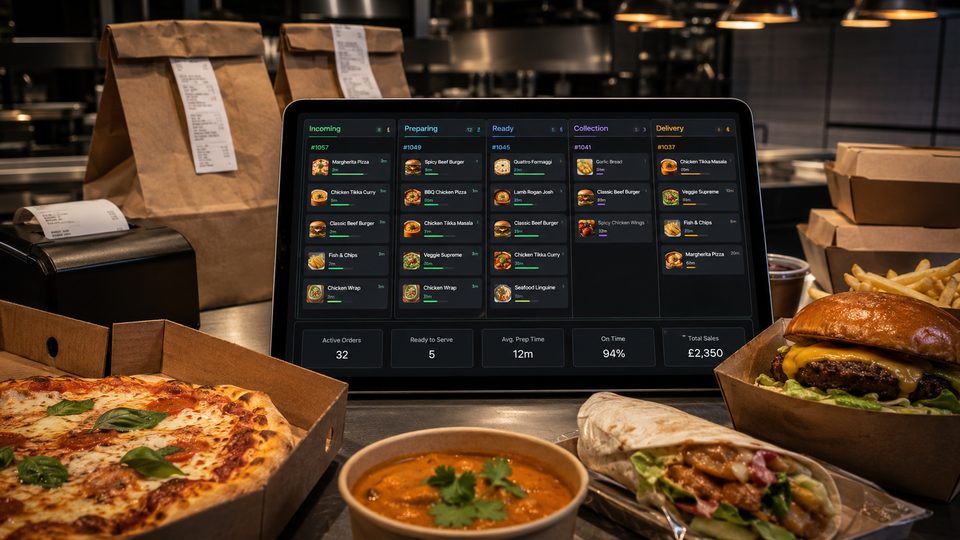 POS and Kitchen SystemsKitchen Display System GuideA kitchen display system can improve visibility and order control, but only when it fits the kitchen’s workflow. Buying screens before mapping st…Read guide →POS and Kitchen SystemsKDS for Multi-Station KitchensIn a multi-station kitchen, a KDS must coordinate separate teams without losing the order as a whole. The fryer, grill, preparation section and d…Read guide →POS and Kitchen SystemsKDS Setup and ConfigurationKDS configuration is an operational project, not a screen-installation task. The system must translate menu data into station work, show realisti…Read guide →POS and Kitchen SystemsInternet Connectivity for Takeaway OperationsTakeaway connectivity should be designed around continuity, not headline download speed. Online ordering, payment terminals, POS synchronisation,…Read guide →
 POS and Kitchen SystemsHow to Sync Menus Across ChannelsMenu synchronisation should reduce duplicate work without hiding errors. The goal is not to force every channel to look identical. The goal is to…Read guide →
Connect customer ordering with operations and profit
Use the wider guide library to check the menu, kitchen, fulfilment, payment and financial implications of each decision.
Browse all practical guides